
Hair fall has to be one of the most common things I hear about in the clinic — almost a daily conversation, if I’m honest. Patients bring it up while combing, or they mention finding more strands than usual on the pillow, or in the shower drain after a wash. It starts small. Then it doesn’t stop. And that’s usually when the worry kicks in.
Here’s something I’ve noticed after years of seeing these cases: no two are ever really identical.
Some patients start shedding more after an illness, or a genuinely rough patch in life. Others thin out slowly — hereditary factors, hormones, nutrition, a scalp issue that’s been simmering quietly for months. And once in a while, hair loss is just the visible tip of something else entirely, something that needs real medical attention.
So no, I don’t treat hair fall as a cosmetic complaint. Before I even get near a Homeopathic Treatment for Hair Fall, I want three things: when did it start, what pattern is it following, and what else was going on around that time.
What Causes Hair Fall?
Hair growth depends on more moving parts than most people assume. Which is exactly why “excessive shedding” can trace back to so many different places.
When I’m working through a case, here’s roughly what’s on my mind:
- Physical or emotional stress
- Recent fever or infection
- Nutritional deficiencies
- Rapid weight loss
- Hormonal changes
- Thyroid disorders
- Pregnancy and postpartum changes
- PCOS and other hormonal conditions
- Hereditary or pattern hair loss
- Certain medications
- Scalp conditions
- Tight hairstyles that repeatedly pull on the hair
- Autoimmune conditions such as alopecia areata
Why bother with the cause at all? Because hair loss types behave differently from one another. Some fade once the trigger passes. Others are progressive, and waiting them out isn’t really the safe move.
Which is why I keep telling patients — please stop rotating shampoos and oils every few weeks. Ask the harder question first: why did this actually start?
Hair Shedding and Hair Loss Are Not Always the Same
People use “hair fall” and “hair loss” like they mean the same thing. They don’t, quite.
Losing some hair every day is normal, for what it’s worth. The American Academy of Dermatology notes that shedding around 50 to 100 hairs a day can be normal. It’s when that number jumps noticeably that we start calling it excessive shedding, or telogen effluvium, in medical terms.
Telogen effluvium tends to follow things like:
- High fever or illness
- Major physical stress
- Significant emotional stress
- Childbirth
- Major surgery
- Rapid or substantial weight loss
- Certain changes in medication
What throws people off is the delay. You can recover fully, feel completely fine, and then — weeks, sometimes months later — the shedding shows up out of nowhere.
So in consultations I often ask something that sounds almost unrelated at first:
“What was happening in your life a few months before this started?”
More often than you’d expect, that one question cracks the case open.
Understanding the Different Types of Hair Loss
Telogen Effluvium
Usually shows up as general shedding rather than one obvious bald spot. More hair on the pillow, the comb, the bathroom floor — with a history of fever, illness, childbirth, stress, or a sudden drop in weight sitting somewhere behind it.
Most of the time it settles on its own. If it drags on though, it’s worth asking whether something else is feeding it.
Hereditary Hair Loss
Genetics do a lot of the work here, and honestly, it’s the most common cause of progressive thinning I come across.
In men, it’s often a receding hairline or crown thinning. In women, it tends to be broader — overall thinning, or a parting that keeps widening. Because it creeps up so slowly, plenty of patients don’t come in until it’s already fairly visible.
My take: if it’s progressive thinning rather than a sudden spike in shedding, get it assessed properly. Don’t just wait it out — that rarely works in this particular case.
Alopecia Areata
Different animal entirely. Sudden, smooth, round or oval patches — sometimes eyebrows or eyelashes too. It’s autoimmune; the body turning on its own follicles.
If you spot sudden patchy loss, please see someone qualified. This is not the moment to try random products off the internet.
Scalp-Related Hair Loss
Dandruff, itching, scaling, redness — these show up alongside hair concerns more often than you’d think, and I try to look at both together rather than treating them as unrelated.
One thing worth repeating: persistent scalp symptoms shouldn’t just get waved off as “regular dandruff.”
Hair Breakage Is Not Always Hair Loss
Here’s a mix-up I see constantly — hair falling from the root versus hair snapping along the shaft. Two very different problems, even though they look similar from the outside.
Frequent coloring, chemical treatments, heat styling, rough brushing — all of it weakens the shaft over time. Tight hairstyles pile on more tension, and eventually that can lead to traction alopecia.
So when someone tells me “Doctor, my hair is falling,” step one is figuring out whether it’s actually shedding from the root, or just breaking from damage. That single distinction changes the whole approach.
How Is Hair Fall Evaluated?
For Hair Fall Treatment in Homeopathy, I don’t open with “how many hairs a day.” I want the bigger picture first.
That usually means going through:
- When the hair fall started
- Whether it began suddenly or gradually
- Overall thinning versus patchy loss
- Recent fever, infection, or illness
- Pregnancy or childbirth
- Hormonal changes
- Menstrual history, where relevant
- Thyroid-related concerns
- Recent weight loss
- Eating habits and nutritional intake
- Protein and iron intake
- Stress and sleep patterns
- Family history of hair loss
- Current medications and supplements
- Hair coloring or chemical treatments
- Tight hairstyles
- Dandruff, itching, or scalp irritation
Depending on what comes up, further evaluation or lab work might follow. This step matters because hair loss can sometimes be the first sign of something else — and I’d rather catch it early than miss it entirely.
How Does Homeopathy Approach Hair Fall?
The question that comes up over and over — “Doctor, which is the best homeopathic medicine for hair loss?”
Truthfully? There isn’t one answer that works for everyone.
Homeopathic treatment is, by design, individualized. Two people can walk in with what looks like the exact same hair fall and still have completely different histories underneath it. That’s why homeopathy for hair regrowth was never meant to be picked off an online list — the full case has to be understood first.
And patients deserve honesty here too. Current evidence doesn’t reliably support homeopathy as an effective treatment for any specific health condition, and it shouldn’t be used to delay proper diagnosis or necessary care. Some products labeled “homeopathic,” worth noting, can contain active ingredients — meaning side effects and interactions are possible.
To me, that’s what responsible care actually looks like: listening properly, understanding the condition, and being upfront about what’s known and what isn’t.
Best Homeopathic Medicines for Hair Loss
Search for the Best Homeopathic Medicine for Hair Loss and you’ll find no shortage of remedy lists floating around online.
In traditional practice, remedies like Phosphorus, Natrum Muriaticum, Silicea, Lycopodium, and Fluoric Acid do get considered — but only within the context of the individual case, and the practitioner’s own prescribing approach.
I’d caution pretty strongly against picking a remedy just because a description online happens to match your symptoms. Hair fall after stress isn’t the same as hair fall after childbirth. Genetic thinning is a different story from shedding tied to nutrition, thyroid issues, or a scalp condition. Remedy selection — where homeopathy is the route chosen — needs proper case-taking behind it, not guesswork.
Homeopathic Treatment for Dandruff and Hair Fall
Dandruff and hair fall show up together more often than most people realize.
Some patients notice the itching or flaking first, and the shedding worry follows later. Others already have heavy shedding, and scalp irritation joins in afterward. Either way, I’d rather understand what’s actually happening on the scalp than lump every case under “dandruff-related hair fall” and move on.
If there’s persistent redness, severe itching, pain, crusting, or heavy scaling — that’s the point where professional assessment stops being optional.
Can Stress Cause Hair Fall?
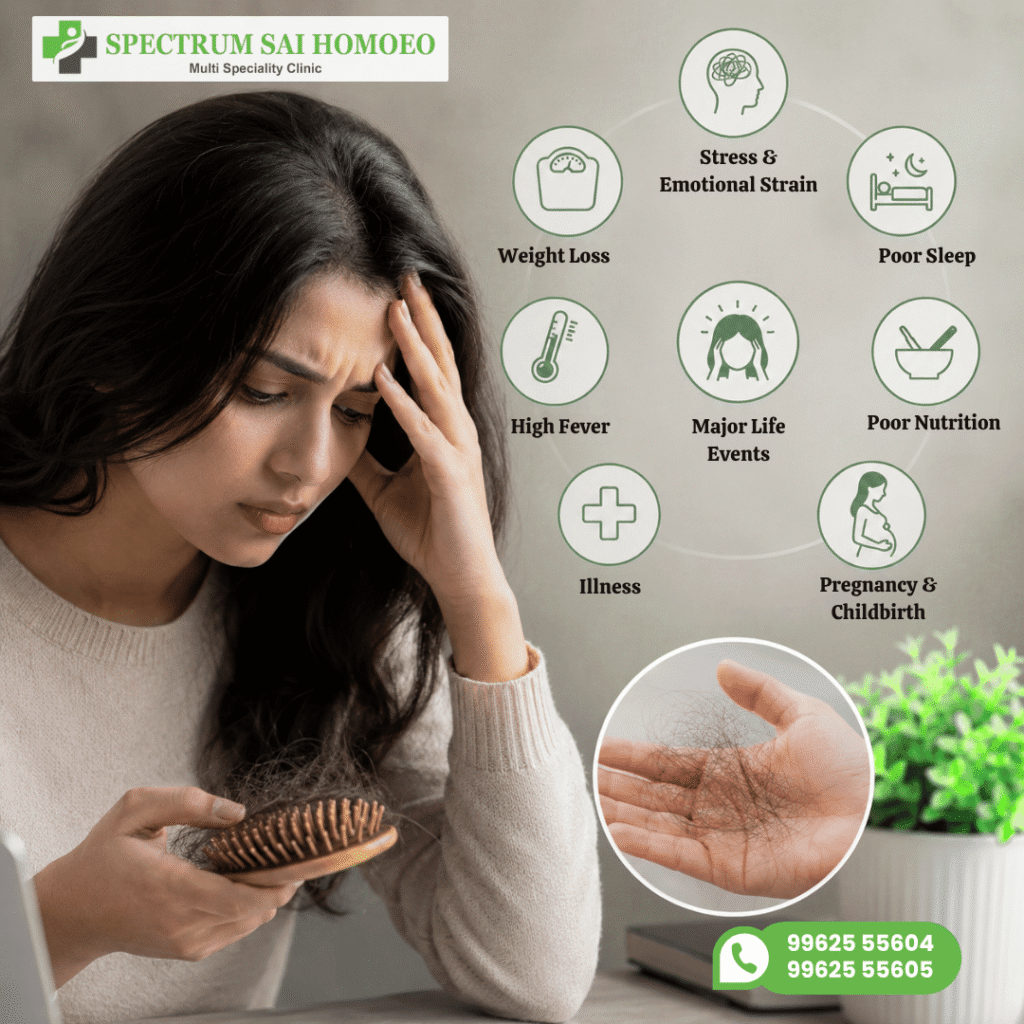
Yes, it can. But I’d push back on the idea that every hair fall case is “just stress” — that’s an easy answer, and easy answers aren’t always right.
I usually ask what was going on weeks or months before the shedding got noticeable. Sometimes it’s:
- A major emotional event
- Prolonged work stress
- Poor sleep
- A serious illness
- High fever
- Significant weight loss
- Changes in eating habits
- Pregnancy or childbirth
Stress has a ripple effect too — disrupted sleep, changed appetite, altered nutrition, all of which feed back into hair health indirectly. And the timeline matters: stress-related shedding usually shows up after the stressful stretch, not during it.
Hair Fall After Pregnancy
Postpartum hair fall comes up a lot — women noticing heavier shedding a few months after delivery, and understandably alarmed by it.
Pregnancy shifts the normal hair-growth cycle, and the hormonal changes after childbirth can trigger noticeable, temporary shedding. The American Academy of Dermatology describes this as telogen effluvium, noting that many women see increased shedding a few months after giving birth. It can genuinely feel scary, watching that much hair come out at once.
Usually, it settles on its own. But if it’s persistent or severe — especially with fatigue, nutritional concerns, or thyroid symptoms alongside it — that’s worth a closer look. A proper assessment separates normal postpartum shedding from something else happening in parallel.
Can Nutrition Affect Hair Growth?
Nutrition matters here, no argument.
Not enough protein, or gaps in certain nutrients, can genuinely contribute to hair loss. Iron, protein, zinc, and biotin come up the most. But that doesn’t mean everyone with hair fall needs to start popping five different supplements tomorrow.
I’d rather understand the diet and general health first. Where it makes sense, we check for an actual deficiency before jumping to supplementation. A balanced diet, enough protein, a decent variety of nutrients — that combination does more for hair health than most people give it credit for.
Hair Care Habits That May Contribute to Hair Problems
Sometimes it’s the small daily habits quietly working against us. Things I flag often:
- Very tight ponytails or buns
- Repeated pulling on the scalp
- Excessive heat styling
- Frequent chemical treatments
- Aggressive brushing
- Rough handling of wet hair
- Excessive use of harsh hair products
Repeated tension from tight hairstyles can lead to traction alopecia, and if it goes on long enough, that damage can turn permanent. Good hair care won’t fix a medical cause underneath — but it does protect the hair that’s already there, which counts for more than people think.
When Should You Consult a Doctor for Hair Fall?
Not every bit of shedding needs alarm bells. But a few signs really shouldn’t be ignored:
- Sudden or rapidly increasing hair loss
- Clearly defined bald patches
- Loss of eyebrows or eyelashes
- Hair loss from other parts of the body
- Significant scalp redness or pain
- Persistent itching or severe scaling
- Progressive thinning
- Hair loss that continues for a prolonged period
- Hair loss with unexplained weight changes
- Significant fatigue or other systemic symptoms
- Hair loss following a major illness or medication change
Sudden or patchy hair loss can point to specific causes that need a real diagnosis, and some types can cause permanent follicular damage if left unattended too long. If I ever think a patient needs a dermatological opinion, further testing, or a different kind of care altogether — I say so. That’s just part of doing this responsibly.
What Can You Expect From Homeopathy Hair Loss Treatment?
Something I tell every single patient upfront: hair growth takes time. Follicles run on their own cycle, so visible change doesn’t happen overnight, no matter what an ad promises.
The timeline shifts a lot depending on the cause, too. Someone with temporary shedding post-illness is looking at a completely different course than someone with years of hereditary thinning. Patchy loss needs its own clinical read altogether.
So I won’t promise every patient the same result by some fixed week — I never have. I’d rather do regular follow-ups and track actual progress as it happens. And this bears repeating: Homeopathy Hair Loss Treatment isn’t meant to replace proper evaluation or established medical treatment when an underlying condition genuinely calls for it.
What Makes Spectrum Sai Homoeo’s Approach Different?
At Spectrum Sai Homoeo, we’ve learned — the hard way, sometimes — that hair fall is rarely just about appearance. For a lot of patients, it touches confidence, routine, even mood. So we take the time to understand the person, not just the symptom sitting in front of us.
When someone comes to us for Homeopathic Treatment for Hair Fall, we go through the whole history — how it started, what’s alongside it, lifestyle, stress, diet, past illnesses, hormonal factors where relevant, the rest of the health picture too. We watch the pattern and how it’s progressing, rather than treating every case like a copy of the last one.
The goal was never to hand someone another bottle for the scalp. It’s understanding the complete picture, talking through the right approach honestly, and staying with the patient as things move forward — because two people can have the exact same amount of hair fall and still be dealing with entirely different reasons behind it.
Simple Steps You Can Take While Managing Hair Fall
A handful of things that genuinely help, in my experience:
- Eat a balanced diet with adequate protein
- Avoid crash diets and unnecessary food restrictions
- Reduce excessive heat and chemical treatments
- Avoid hairstyles that pull tightly on the scalp
- Be gentle when brushing and handling wet hair
- Maintain appropriate scalp hygiene
- Manage ongoing stress as best you can
- Get adequate sleep
- Skip the pile of supplements unless you actually know you need them
- Seek professional evaluation if the hair fall is sudden, severe, or persistent
These steps support overall hair and scalp health, but let’s be clear — they’re not a replacement for actually finding out what’s causing persistent hair loss.
Frequently Asked Questions
Is homeopathy effective for hereditary hair loss?
Hereditary hair loss carries a strong genetic component and tends to progress gradually — get the pattern properly assessed first. Patients choosing homeopathy should also know current scientific evidence doesn’t establish it as effective for specific types of hair loss.
How long before I see results from hair fall treatment?
Honestly, there’s no fixed timeline. Hair moves in cycles, and how long improvement takes depends on the cause, how long it’s been going on, and individual factors. I always steer patients toward identifying the cause first, rather than fixating on a regrowth date.
Can stress-related hair fall grow back?
Often, yes — especially once the trigger has settled. But shedding that continues or worsens shouldn’t automatically get blamed on stress alone.
Can dandruff cause hair fall?
Scalp conditions can occur alongside shedding or breakage. Persistent itching, redness, scaling, or inflammation deserves real evaluation, not just a cosmetic fix.
Should I take iron or biotin for hair loss?
Not automatically. Better to review diet, symptoms, and relevant medical factors first. Taking supplements without a confirmed need might not touch the actual cause at all.
Can I continue using shampoo during treatment?
Yes, absolutely. Scalp hygiene still matters — a suitable shampoo and gentle routine can usually continue unless your healthcare professional says otherwise.
Is daily hair shedding normal?
Some shedding every day is completely normal — around 50 to 100 hairs is the commonly cited range. Excessive shedding is a different story, often following illness, childbirth, major stress, or significant weight loss.
When should I be concerned about hair loss?
Sudden hair loss, patchy bald spots, eyebrow or eyelash loss, scalp inflammation, significant thinning, or hair loss alongside other symptoms — all worth a professional look.
The Bottom Line
In our practice, we see every kind of hair fall case imaginable. Some patients arrive after a fever, illness, childbirth, or a long stretch of stress. Others have been dealing with gradual thinning for years. And some turn out to have nutritional, hormonal, or scalp issues layered underneath.
Every now and then, what a patient calls “hair fall” turns out to actually be breakage, a scalp problem, or a completely different type of hair loss altogether.
If there’s one thing all this experience has taught us, it’s this — hair fall was never meant to be treated as one-size-fits-all. The same symptom can come from very different places in different people, which is exactly why history, pattern, and timing matter as much as they do.
If you’ve been cycling through shampoos, oils, and supplements without really knowing why your hair is falling, maybe it’s time to look at it more carefully instead of trying one more product.
At Spectrum Sai Homoeo, we take the time to understand each patient’s case before we ever get to treatment. If you’re looking for Good Homeopathy Doctors in Chennai, or exploring Homeopathic Treatment for Hair Fall, a proper consultation is a solid place to start.
Hair fall is visible on the outside — the reasons behind it, though, are usually far more layered than they first appear.
Understanding the cause is where real care actually begins.
Read more on: